
UV Laser Engraving Machine: Precise plate making, cost savings and efficiency improvements, empowering global textile printing innovation.
Core Principles, Cost Reduction and Efficiency Improvement
1.1 Working Principle: Intelligent direct drive, precise and controllable
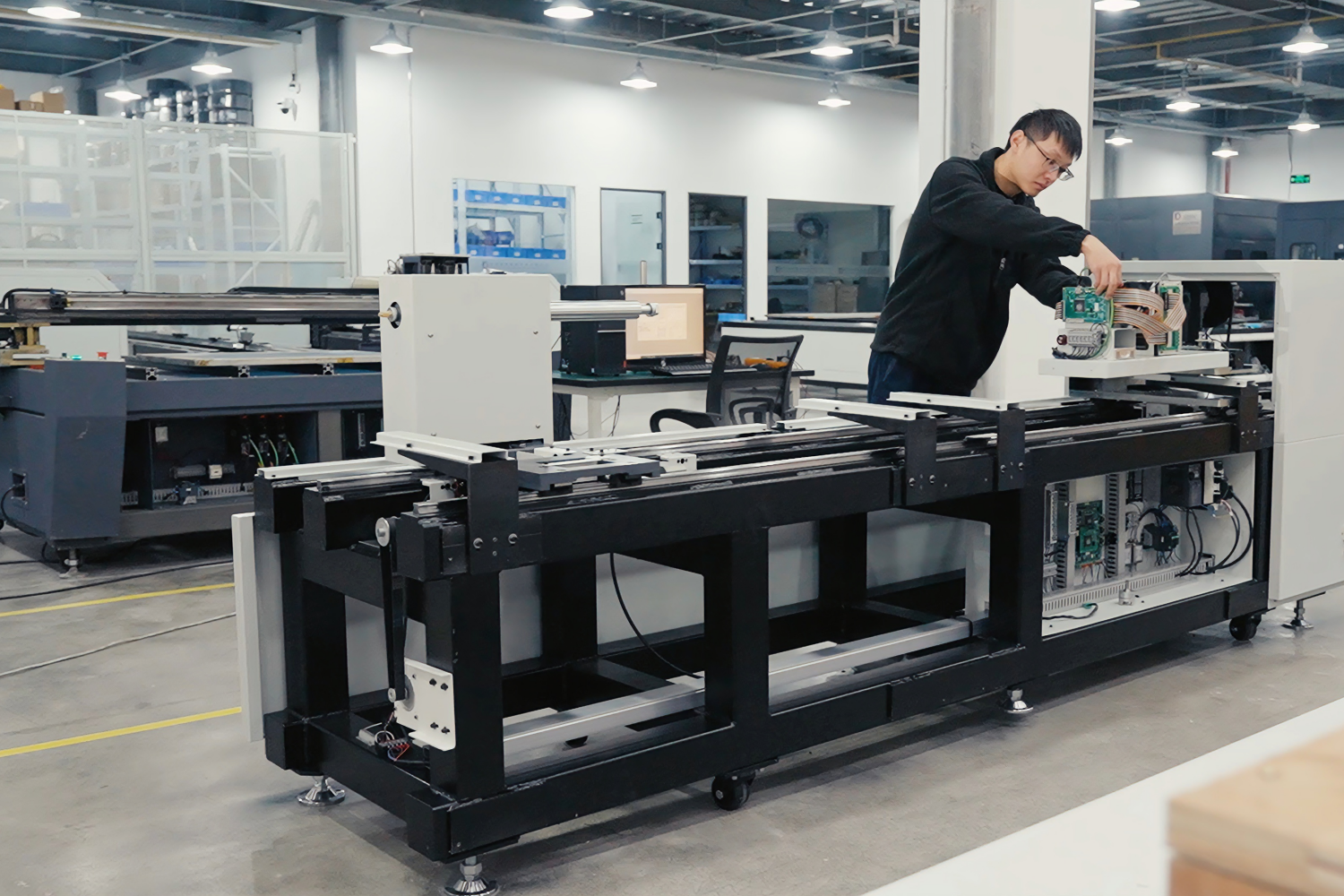
Our UV Laser Engraving Machines( including rotary engraver and flat engraver series) employ advanced Nichia UV laser light source technology, coupled with a self-developed high-performance optical system and intelligent control module. Their core principle is to selectively cure the photosensitive emulsion on the screen surface using a UV laser beam based on a digital pattern file.
The core difference from traditional screen making processes:
Unlike traditional screen-making processes that rely on film and multiple rounds of manual operation, our UV Laser Engraving Machine achieves seamless integration from pattern design (supporting TIFF/BMP formats) to screen engraving—digital files are directly transferred to the equipment, automatically completing the entire process of exposure, development, and curing. The core processes operate intelligently and precisely throughout, without human intervention, ensuring the stability and consistency of screen-making quality.
1.2 Cost Reduction Advantages: Data-Driven Cost Savings (Comparison of Traditional engraving and CO₂ Laser Engraving)
Based on real-world application data from global printing and dyeing enterprises, our UV Laser Engraving Machine achieves significant cost reductions compared to traditional engraving and CO₂ laser engraving solutions:
| Cost categories | Our UV Laser Engraving Machine | CO₂ Laser Engraving Machine | Traditional engraving / inkjet printing | Compared to CO₂ lasers , it saves | Compared to traditional/inkjet, it saves |
| Cost per screen | Round per screen series (JD2200RD/JD3500RD): 640×1800mm size, only $0.3-$0.5. | $1.2-$1.5 per screen (for reference only, same size) | Inkjet screen printing: requires specialized inks, resulting in higher costs. | 60%; saving $9,000-$10,000 per year on 10,000 screen. | Annual savings of $5,000-$8,000 in consumable costs |
| Consumable costs | Only UV light and photosensitive emulsion are required; no additional consumables are needed. | There is wear and tear on laser-related consumables. | Inkjet screen printing: requires specialized inks, cleaning solutions, etc.; Traditional engraving: requires film , developing solutions, etc. | No additional consumables required, significantly superior to CO₂ lasers . | Zero additional consumables, saving $5,000-$8,000 annually (compared to inkjet). |
| Energy consumption | The standard model has a power output of only 2 kW/hour. | 12 kW/h | Similar products on the market: approximately 3.08 kW/h | 83%; saving 80 kWh of electricity per day for 8 hours of operation, resulting in annual electricity savings of $4,800- $6,000 (based on $0.15/kWh). | 35%; considerable annual electricity savings |
| scrap rate | ≤2% (98%+ first-pass yield), high-end models include automatic calibration function. | A first-pass yield rate of over 98% | Traditional engraving manufacturing has a 15% lower first-pass yield. | Scrap loss significantly reduced | 10,000 screen per year reduces waste losses by $4,000-$14,500 (based on $40-$145 per screen). |
1.3 Efficiency Improvement: Accelerate production cycles and adapt to diverse needs
Engraving speed comparison:
– Rotary UV Laser Engraving Machine: 640×1800mm screen prints require only 8 minutes per screen; 40 prints can be produced in an 8-hour shift.
– CO₂ Laser Engraving Machine: 40 minutes/screen for the same specifications; only 15 screen are produced in an 8-hour shift.
– Traditional engraving: 16 minutes/screen; efficiency is only 1/2 that of UV Laser Engraving Machines.
The rotary UV Laser Engraving Machine is 5 times faster than CO₂ Laser Engraving Machine and 2 times faster than traditional engraving. It also supports 24-hour continuous operation, which is perfectly matched to the pace of large-scale mass production.
Core operation and adaptation advantages:
– Intelligent automated operation: High-end models (JD2200RDA/JD3500RDA) are equipped with autofocus and pressure monitoring functions, reducing operator training time from 1 week to 1 day, significantly reducing labor costs.
– Wide compatibility: The rotary screen series supports screens with a circumference of 530-1018mm and an effective engraving width of 500-3500mm; the flat screen series (JD1210FC/JD3532FC) covers engraving sizes from 1200×1000mm to 3500×3200mm, adapting to diverse needs such as textile printing, home textiles, and industrial fabrics.
– Seamless integration with digital printing: screen registration accuracy ≤20 microns, perfectly matching 32-head/64-head digital printing machines such as Kyocera KJ4B/Ricoh G6; reducing the connection time from screen engraving to printing by 30%, enabling rapid response to small-batch and personalized orders.
Core Advantages: Why Choose Our UV Laser Engraving Machine?
As a national high-tech enterprise with over 15 years of experience in the dyeing and printing industry, we serve more than 200 clients worldwide, with over 400 sets of equipment operating stably, providing unparalleled core value to our overseas clients:
- Leading core technologies: Adopting original Nichia UV laser light source and customized optical lens group, the optical system has a lifespan of 50,000 hours (twice the industry average); independently developed intelligent control system, achieving adjustable precision of 600-1440 DPI to meet the needs of high-end printing.
- Enriched product portfolio: Covering both rotary screen (standard/high-end models) and flat screen (standard/DMD high-precision models) UV Laser Engraving Among them, the DMD flat screen models (JD1213FE/JD2535FE) achieve an ultra-high precision of 2540 DPI, suitable for high-definition printing scenarios such as sports brand logos and industrial circuits.
- Global Compliance and Environmental Protection: The entire process produces zero VOC emissions and no harmful gases, fully complying with EU REACH and US EPA environmental standards. It avoids the pollution risks of chemical mesh manufacturing and the health hazards of laser dust, helping companies achieve sustainable production.
- Global end-to-end service: The wholly-owned subsidiary Hangzhou Xiongyue Technology provides customized installation, 24/7 technical support (average response time < 4 hours) and on-site training; service centers are located in 12 countries and regions including Germany, the United States, and India to ensure timely after-sales response.
- Mature Industry Experience: The core team consists of engineers with over 15 years of experience; the equipment is CE, FCC, and ISO9001 certified and has been validated and used by over 500 companies in 30 countries. It can seamlessly integrate with existing production lines, reducing modification costs by 30% compared to replacing the entire production line.
Core Beneficiary Customers
– Large-scale printing and dyeing enterprises: 24-hour continuous operation + 5 times the speed of CO₂ laser engraving, meeting the efficiency requirements of large-scale mass production; 98%+ first-pass yield significantly reduces rework costs.
– Medium-sized factories: Significant cost reduction advantages (low energy consumption, zero additional consumables) + simple operating procedures, accurately matching cost control needs and reducing operational pressure.
– Startups and high-end printing factories: 2540DPI ultra-high precision (DMD model) + flexible adaptation to small batch orders, helping to expand into the high-end market; environmental compliance attributes are in line with the brand’s sustainable development positioning.
Call to Action
Contact us now for a customized quote and unlock the new potential of efficient, low-cost, and high-precision engraving! Whether you’re pursuing mass production efficiency, focusing on cost control, or seeking a high-precision screen printing solution, our Blu-ray players will provide you with a tailored value experience!